

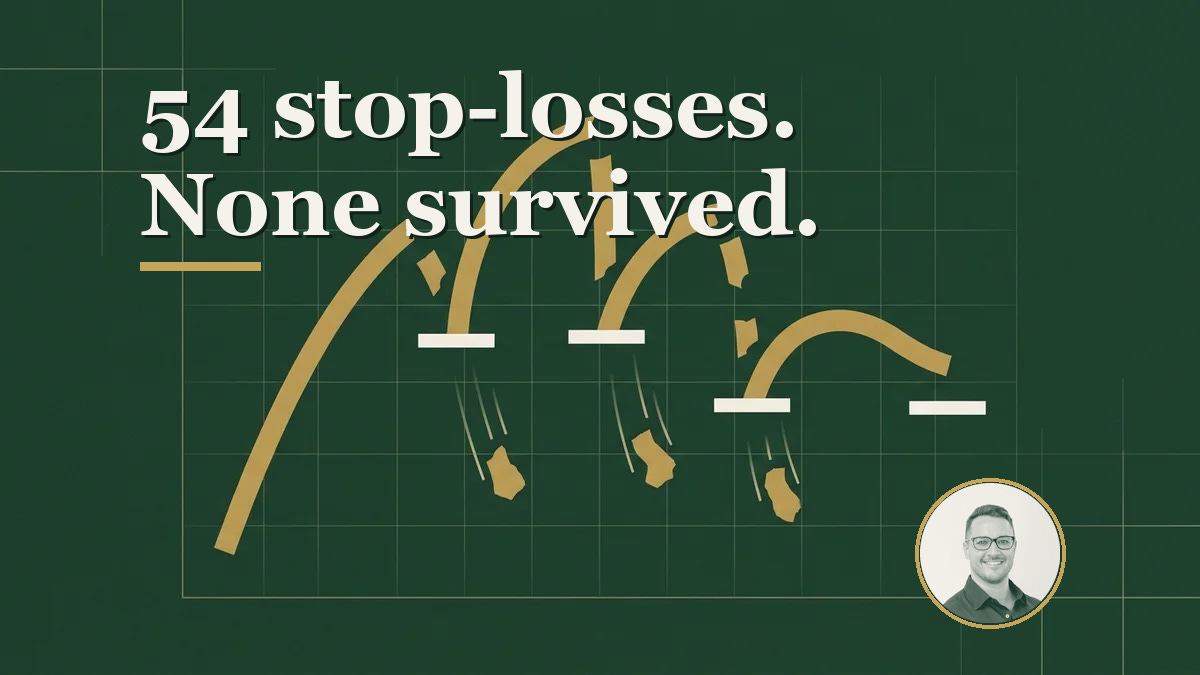
Ask anyone what a leveraged ETF position needs and you get the same answer: a stop-loss. It sounds obviously right. TQQQ can fall 20% in a week, so cap the damage and re-enter later. I believed it too. Then I tested it, because my own money runs on this strategy and “sounds obviously right” is not a risk model.
The setup
The base is a rules-based 3x Nasdaq-100 strategy I trade with real money and document publicly. The backtest runs on synthetic 3x data from 1999 to 2026, built from the underlying index, so it includes the dot-com crash, 2008, the 2020 crash and the 2022 bear market, not just the friendly decade TQQQ has actually existed for. On top of that base we tested 54 stop-loss configurations: trailing stops and stop-limits, tight to wide, evaluated separately across market regimes.
The question was simple. Does any stop-loss configuration improve the strategy’s risk-adjusted outcome across regimes, rather than in one lucky window?
What happened
Three patterns, and they killed every candidate:
Tight stops died by whipsaw. Anything tight enough to matter in a real crash triggered constantly in normal 3x volatility. A 3x fund moving 4% on an ordinary Tuesday hits a tight stop, sells, and buys back higher after the rebound. Each round trip is small. A hundred of them are not. Death by a thousand paper cuts, compounded.
Wide stops did not protect. Set the stop wide enough to survive normal volatility and it only triggers after the damage you were trying to avoid has already happened. You lock in the loss near the bottom, then face the re-entry problem with less capital.
The lone survivor was a fluke. Exactly one configuration looked like an improvement. We attacked it: shifted the regime windows, perturbed the parameters, re-ran it on adjacent configurations. It fell apart. A robust edge survives its neighbors. This one was a coincidence with good marketing.
Why stops and 3x funds do not mix
Leveraged ETFs reset daily. Their volatility is not just larger, it clusters: calm for months, then violent in both directions. A stop-loss is a bet that prices move smoothly enough to exit near your trigger, and that big down moves keep going. In a 3x instrument, both assumptions fail regularly. The biggest up days live right next to the biggest down days, and a stop guarantees you hold through the former and miss the latter.
I did not only learn this in a backtest. My live account ran a trailing stop in an earlier version of the system. It executed at an awkward moment for a technical reason no backtest would ever show. Real trading finds failure modes on its own.
What works instead (in the data)
The strategy that survived all of this does something less satisfying than a stop: it decides, on published rules, when the environment justifies holding a 3x position at all, and goes to cash when it does not. Over 1999–2026 that turns an unmanaged 3x position (27.3% CAGR with drawdowns beyond 80%) into 30.7% CAGR with a worst drawdown of 48.3%. Backtested numbers, labeled as such; the live account has been documented publicly since 2025.
A 48% drawdown is still brutal. I publish it because it is true, and because everyone promising leveraged returns with 15% drawdowns is selling you the thing this article just tested.
The honest summary
54 stop-loss variants, tested across regimes: zero robust survivors.
Tight stops bleed you dry, wide stops arrive late, the one “winner” was noise.
If your leveraged ETF plan is “buy and use a stop-loss”, the data says you have a plan for feeling safe, not for being safe.
Every trade of the real account, and the rules it follows, are public here: https://www.tradingautomation.de/live. The Weekly Ledger documents it every week.
The Honest Curve is a publication that documents my own real-money account and my research. It is general information addressed to all readers, not personalized investment advice, and no recommendation to buy or sell any security. Leveraged ETFs are volatile and can lose most of their value; my worst backtested drawdown exceeded 48%, and an unmanaged 3x position would have lost more than 80% at times. I hold positions in the instruments I write about and I trade them according to the published rules. Past performance, live or backtested, does not predict future results.